Wholesaling PPC is a paid advertising strategy that helps real estate wholesalers reach homeowners actively searching Google for ways to sell their properties. Instead of relying entirely on outbound methods such as cold calling or direct mail, wholesalers can use Google Ads to attract motivated sellers, generate calls and form submissions, and turn qualified opportunities into contracts and closed deals.
But successful wholesaling PPC is not simply about bidding on phrases such as “sell my house fast.”
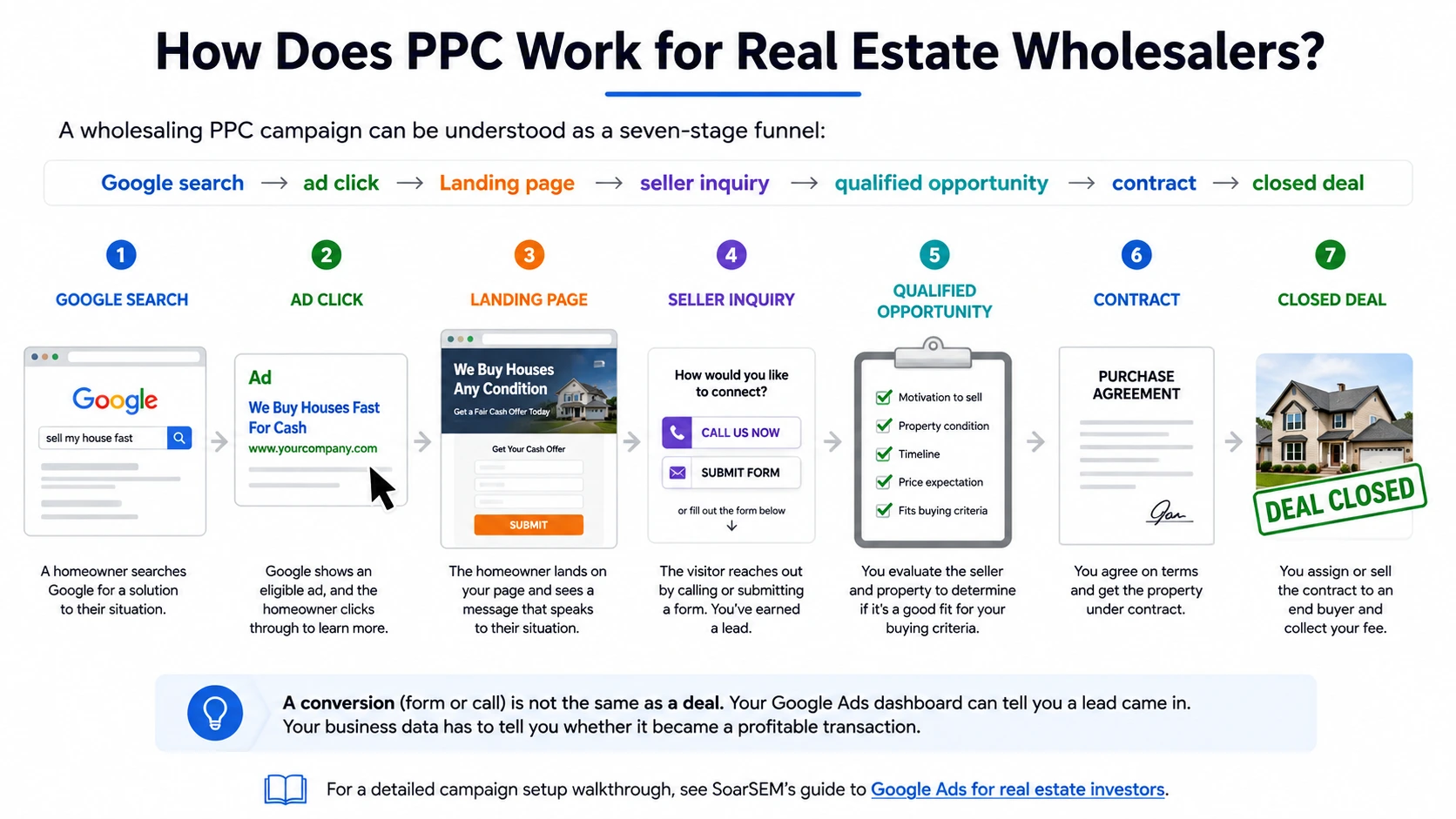
The complete funnel looks more like this:
Search → Google Ad → Landing Page → Motivated Seller Lead → Qualified Opportunity → Contract → Closed Deal
Every stage affects profitability.
That is why the most useful PPC metrics are not necessarily clicks or even leads. Real estate wholesalers ultimately need to understand how much it costs to generate qualified seller opportunities and closed deals.
What Is Wholesaling PPC?
Wholesaling PPC is pay-per-click advertising designed to generate motivated seller leads for real estate wholesalers. Most campaigns use Google Search Ads to reach homeowners searching for ways to sell quickly, receive a cash offer, sell a difficult property, or solve another property-related problem.
With PPC advertising, the advertiser generally pays when someone clicks an ad.
For example, a homeowner might search:
- sell my house fast
- cash home buyers near me
- sell my house for cash
- sell inherited house
- need to sell my house quickly
A real estate wholesaler can advertise for relevant searches and direct that person to a landing page where the seller can call, request an offer, or provide property details.
The major advantage is search intent.
With cold outreach, the wholesaler initiates the conversation.
With Google Search PPC, the homeowner has already gone to Google looking for information or a solution.
That does not mean every click will become a qualified lead. It means PPC can help wholesalers reach sellers at a point when they are actively researching what to do with a property.
How Does PPC Work for Real Estate Wholesalers?
A wholesaling PPC campaign typically follows seven stages:
- A homeowner searches Google.
- A relevant Google Ad appears.
- The homeowner clicks the ad.
- The visitor reaches a landing page.
- The homeowner calls or submits a form.
- The wholesaler evaluates the opportunity.
- Qualified opportunities may progress to contracts and closed deals.
Google Ads determines whether an advertiser is eligible to appear based on factors including targeting, keywords, bidding, relevance, competition, and other auction signals.
After the click, the landing page has to continue the conversation.
If a homeowner searches for a fast cash sale but lands on a vague real estate homepage, the experience may not match the original intent.
The lead then enters the wholesaler’s acquisitions process.
That process typically determines:
- why the homeowner wants to sell;
- how quickly they want to sell;
- the property’s condition;
- the property’s location;
- the seller’s expectations;
- whether the property fits the wholesaler’s acquisition criteria.
This is where an important distinction appears:
A PPC conversion is not automatically a qualified seller opportunity.
Your advertising platform can tell you a form was submitted. Your business data needs to tell you whether that form eventually became a viable deal.
For a deeper walkthrough of campaign setup, targeting, bidding, and optimization, read SoarSEM’s guide to Google Ads for real estate investors.
Why Are PPC Leads Different From Other Wholesaling Leads?
Google Search PPC differs from many traditional wholesaling lead-generation methods because it captures existing demand.
Imagine two homeowners.
The first receives an unsolicited call asking whether they would consider selling a property.
The second searches Google for:
“sell my inherited house fast.”
Both homeowners could eventually become motivated sellers, but the second homeowner has demonstrated explicit search intent.
That is why Google Search PPC is an inbound acquisition channel.
The wholesaler is not creating demand from scratch. Instead, the campaign attempts to put the business in front of someone already searching for an answer.
The challenge is competition.
Other wholesalers, investors, agents, marketplaces, and home-buying companies may also bid on motivated-seller searches.
Successful PPC therefore requires more than traffic.
You need to attract searches with appropriate intent, convert the right visitors, qualify leads effectively, and follow those leads through to actual business outcomes.
If you want to understand the situations that may cause homeowners to seek a fast or alternative sale, see SoarSEM’s guide to motivated house sellers.
Is Wholesaling PPC Profitable?
Wholesaling PPC can be profitable when the cost of acquiring closed deals remains below the amount the business can afford to spend on customer acquisition. Profitability depends on the market, click costs, conversion rates, lead quality, acquisitions performance, average deal economics, follow-up, and campaign management.
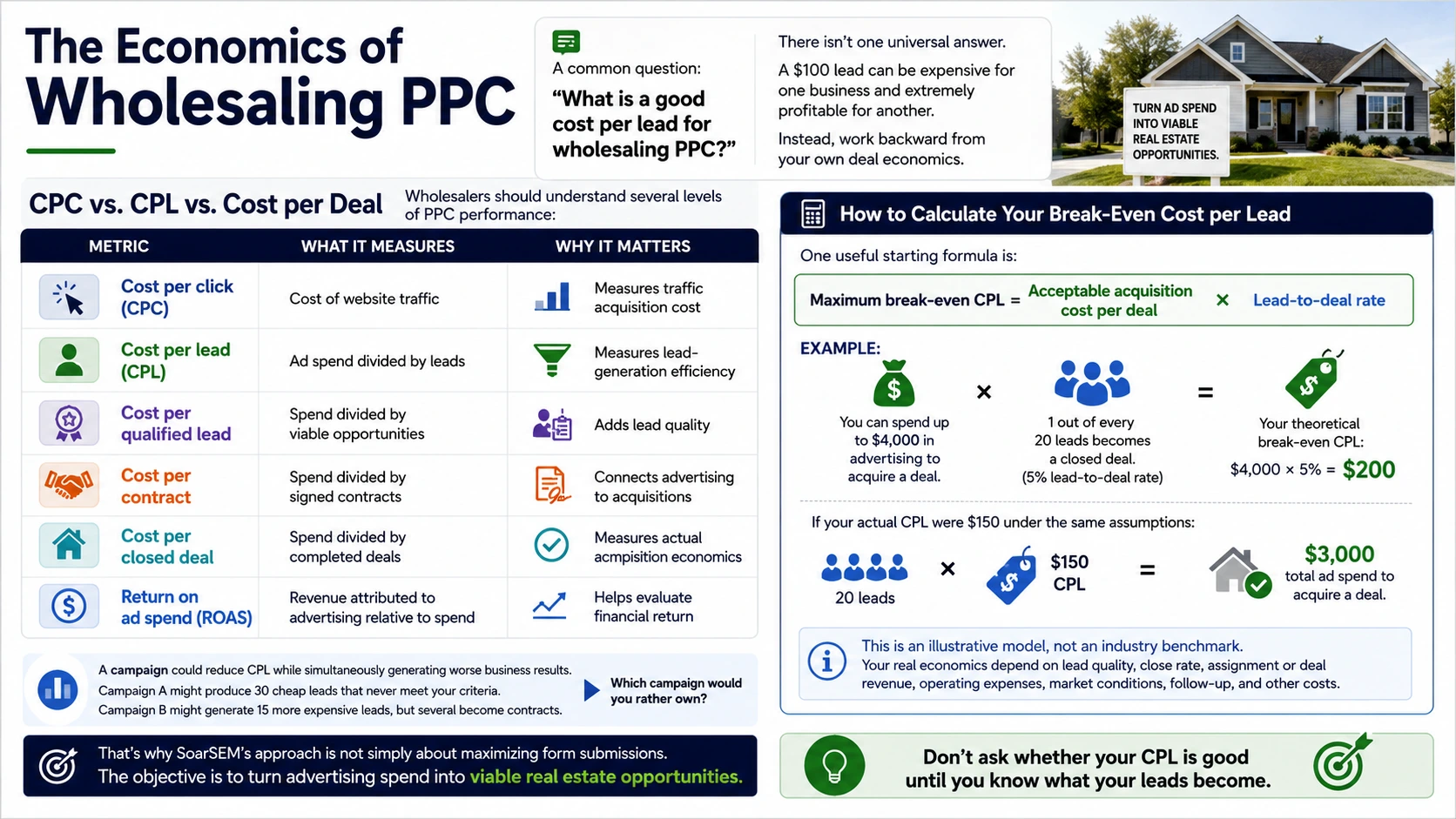
This is why one universal “good cost per lead” does not exist.
A $100 lead might be unprofitable for one wholesaler and highly valuable for another.
The better approach is to work backward from your own economics.
CPC vs. CPL vs. Cost per Deal
Wholesalers should evaluate PPC at several levels.
| Metric | What It Measures | Why It Matters |
|---|---|---|
| Cost per click | Cost of acquiring website traffic | Shows traffic acquisition cost |
| Cost per lead | Ad spend divided by leads | Measures lead-generation efficiency |
| Cost per qualified lead | Spend divided by viable seller opportunities | Adds lead quality |
| Cost per contract | Spend divided by signed contracts | Connects PPC with acquisitions |
| Cost per closed deal | Spend divided by completed deals | Measures acquisition economics |
| Return on ad spend | Revenue attributed to ads relative to spend | Helps evaluate financial return |
A lower CPL is not always an improvement.
Imagine one campaign generates 40 inexpensive form submissions but only one becomes a qualified opportunity.
Another campaign generates 15 more expensive leads, but five become legitimate acquisition opportunities.
The second campaign could create more value despite having the higher CPL.
That is why PPC optimization should not stop at lead volume.
The more important question is what those leads become.
How Do You Calculate a Break-Even Cost per Lead?
A simple planning formula is:
Maximum break-even CPL = acceptable cost per deal × lead-to-deal conversion rate
Suppose a wholesaler is willing to spend up to $4,000 in advertising to acquire one closed deal.
If one out of every 20 leads becomes a deal, the lead-to-deal conversion rate is 5%.
The calculation is:
$4,000 × 5% = $200
In that simplified example, $200 would be the theoretical break-even CPL.
If leads instead cost $150:
20 leads × $150 = $3,000
The advertising cost to acquire the deal would be approximately $3,000 under those assumptions.
This is an illustrative framework, not an industry benchmark.
Actual economics depend on factors such as:
- average deal revenue;
- lead quality;
- contract rate;
- close rate;
- market conditions;
- disposition performance;
- follow-up effectiveness;
- operating costs.
The important principle is:
Do not decide whether your CPL is good until you understand what your leads turn into.
What Are the Best Google Ads Keywords for Wholesaling?
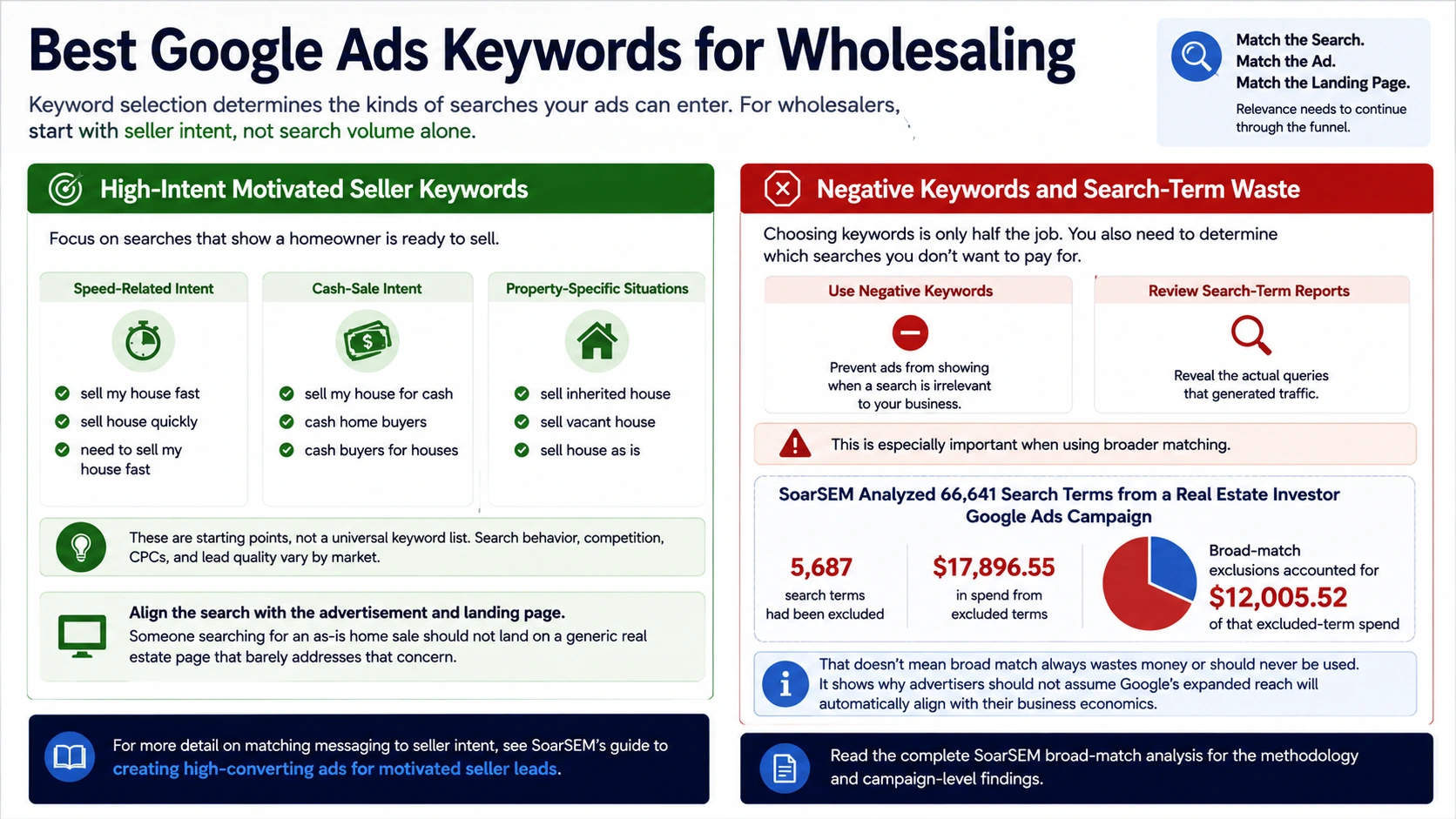
The best PPC keywords for real estate wholesalers generally show clear seller intent.
Rather than choosing keywords based only on search volume, consider what the search suggests about the person’s situation and likely goal.
High-Intent Motivated Seller Keywords
Potential keyword themes include:
Speed-related searches
- sell my house fast
- sell house quickly
- need to sell my house fast
Cash-sale searches
- sell my house for cash
- cash home buyers
- cash buyers for houses
Property-situation searches
- sell inherited house
- sell vacant house
- sell house as is
These examples are starting points rather than a universal list.
Performance varies by location, competition, search behavior, match type, landing page, and acquisitions process.
A useful keyword strategy also maintains relevance from beginning to end:
Search → Keyword → Ad → Landing Page → Offer
Someone searching about selling an inherited house, for example, should ideally see messaging that is relevant to that situation instead of generic real estate copy.
For more on ad messaging and seller intent, read SoarSEM’s guide to creating high-converting ads for motivated seller leads.
Why Are Negative Keywords Important for Wholesaling PPC?
Negative keywords help prevent Google Ads from appearing for searches that are irrelevant or unlikely to produce the type of seller lead you want. They are particularly important when broader keyword matching introduces searches outside your intended audience.
Choosing target keywords is only half of PPC keyword management.
You also need to know which searches you do not want to pay for.
For example, a campaign may begin matching against informational, employment-related, rental, buyer, educational, or other searches that have little value to the wholesaler.
Search-term reports reveal the actual queries that generated traffic.
Those reports can help identify:
- irrelevant searches;
- potential negative keywords;
- new keyword opportunities;
- unexpected intent;
- patterns of wasted spend.
SoarSEM analyzed 66,641 search terms from a real estate investor Google Ads campaign.
In that dataset, 5,687 search terms had been excluded and represented $17,896.55 in spend. Broad-match exclusions accounted for $12,005.52 of the excluded-term spend.
The lesson is not that broad match should never be used.
The lesson is that advertisers should monitor the searches they are paying for instead of assuming expanded reach automatically equals profitable reach.
See the full SoarSEM analysis of broad-match keywords and wasted PPC spend.
How Should a Wholesaling PPC Campaign Be Structured?
A wholesaling PPC account should make it easy to understand where budget is being spent and which types of seller intent are producing meaningful results.
Depending on search volume and market size, campaign or ad-group themes may include:
- sell-fast searches;
- cash-offer searches;
- inherited-property searches;
- distressed-property situations;
- geographic markets.
But more segmentation is not automatically better.
Overly fragmented accounts can spread data too thinly, especially in markets with limited search volume.
The goal should be:
Control + relevance + enough data to make informed decisions.
Your keywords should align with your ads.
Your ads should align with your landing pages.
Your tracking should identify what happens after the visitor converts.
For a deeper look at Google’s relevance signals, read SoarSEM’s guide to Google Ads Quality Score for real estate investors.
Why Does the Landing Page Matter So Much?
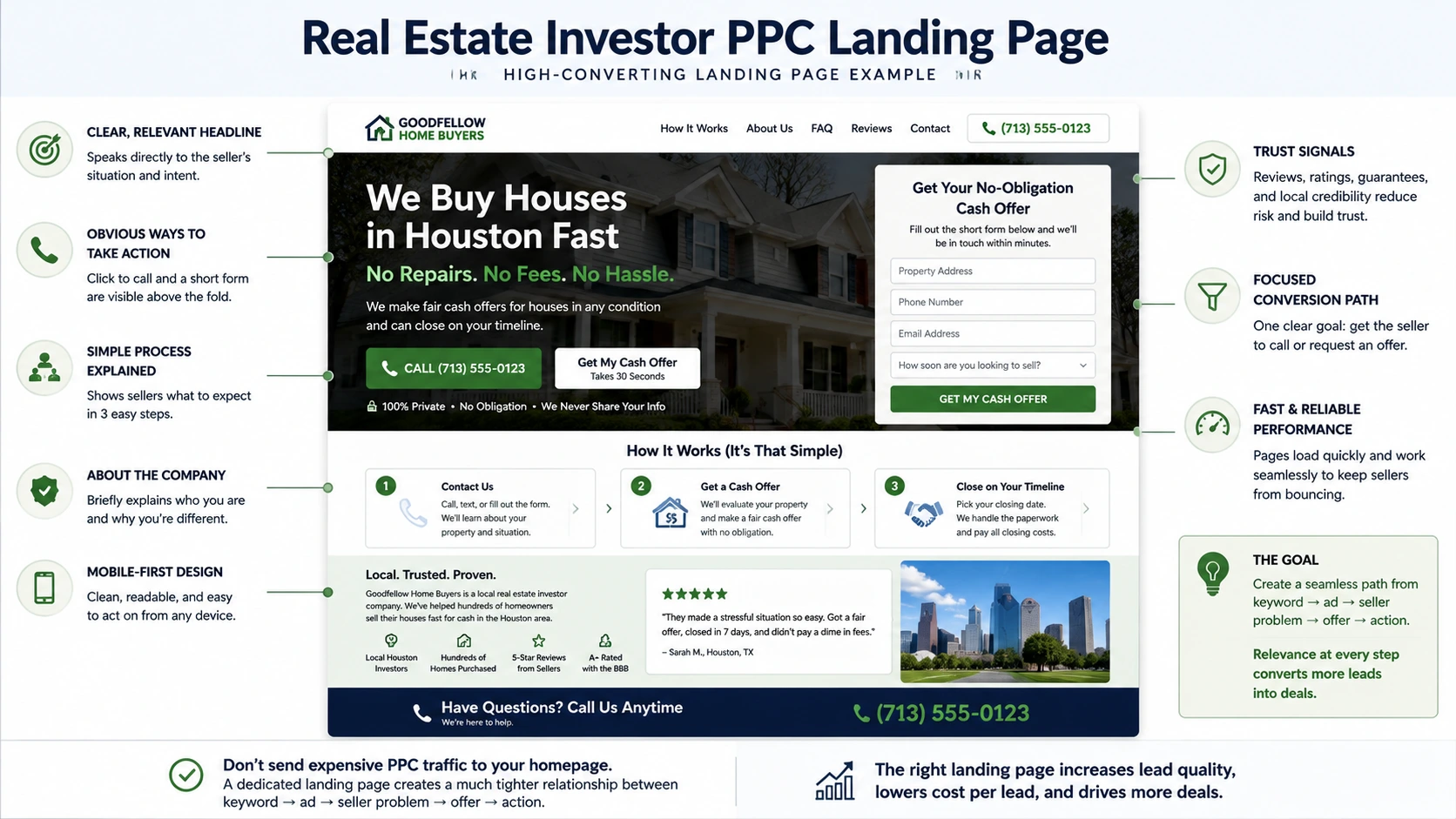
The landing page is where paid traffic becomes a potential seller lead.
A well-targeted ad can still fail if the page does not answer the visitor’s questions quickly.
A homeowner arriving from Google may immediately want to know:
Am I in the right place?
Can this company help with my situation?
Why should I trust this business?
What happens after I submit my information?
A strong wholesaling PPC landing page generally needs:
- a clear seller-focused headline;
- a visible call or form option;
- messaging that matches the searcher’s situation;
- a simple explanation of the process;
- information about the business;
- relevant and verifiable trust signals;
- mobile-friendly design;
- a focused conversion path;
- reliable page performance.
Sending every paid click to a generic homepage can create unnecessary friction.
A dedicated landing page lets the wholesaler create a stronger connection between:
Keyword → Ad → Seller problem → Offer → Action
How Should Wholesalers Track PPC Leads?
Wholesalers should ideally track PPC leads beyond the initial call or form submission.
Basic conversion tracking answers:
Which campaigns generate calls and forms?
More advanced attribution answers:
Which campaigns, keywords, and searches generate qualified leads, contracts, and closed deals?
Those are far more valuable questions.
A practical lead pipeline could include stages such as:
New lead → Contacted → Qualified → Appointment or offer → Contract → Closed deal
Tracking these stages helps reveal whether apparently strong campaigns are actually producing useful opportunities.
For example, suppose one keyword generates 50 leads and another generates 20.
At first glance, the first keyword looks better.
But if the first produces one qualified seller and the second produces eight, the business conclusion changes dramatically.
This is why the advertising platform should not be the only source of truth.
Where possible, connect PPC activity with CRM, call-tracking, acquisitions, and deal data.
Why Do Wholesaling PPC Campaigns Waste Money?
Wholesaling PPC campaigns typically waste money when traffic, conversion tracking, landing pages, or business outcomes are poorly aligned.
Here are seven common causes.
1. Targeting Searches Without Enough Seller Intent
Not every real estate search comes from someone who owns a property and wants to sell it.
Broad traffic can increase clicks without improving deal flow.
Start with the problem your ideal seller is actively trying to solve.
2. Ignoring Search-Term Reports
Keywords are what advertisers target.
Search terms are what people actually type.
Reviewing those queries can reveal irrelevant traffic, unexpected patterns, and negative keyword opportunities.
3. Sending Traffic to a Generic Homepage
A homepage may serve several audiences and purposes.
PPC traffic usually performs better when the landing experience directly continues the conversation started by the search and ad.
4. Optimizing for Lead Quantity Instead of Lead Quality
More forms do not necessarily mean more deals.
Track whether leads fit your target market and acquisition criteria.
5. Incomplete Call and Form Tracking
If calls, forms, or other important conversion actions are not tracked correctly, campaign performance becomes harder to evaluate.
6. Stopping Attribution at the Lead
A keyword can look successful because it generates form submissions while producing few or no contracts.
Connect marketing activity to downstream results whenever possible.
7. Scaling Before the Funnel Is Ready
Increasing spend amplifies the system you already have.
If targeting, tracking, landing pages, or acquisitions are weak, increasing budget can simply increase the cost of those problems.
Use SoarSEM’s pay-per-click optimization checklist when reviewing campaign performance systematically.
How Much Should You Budget for Wholesaling PPC?
There is no universal Google Ads budget that works for every real estate wholesaler. A realistic budget depends on local click costs, competition, search volume, target lead volume, conversion rates, acquisition capacity, and the amount you can profitably spend to acquire a deal.
A simple planning equation is:
Desired number of leads × expected CPL = estimated advertising budget
For example, if a planning model requires 20 leads and assumes a $200 CPL:
20 × $200 = $4,000
That produces an estimated monthly ad budget of $4,000.
But the $200 figure needs to come from campaign data or a clearly identified planning assumption.
It should not be treated as a universal market benchmark.
Once your account produces enough useful data, actual results should replace assumptions.
Budget should also be evaluated in relation to data volume.
In competitive markets, a very small campaign may generate too few clicks and conversions to make confident optimization decisions quickly.
Wholesaling PPC vs. SEO vs. Cold Calling
Wholesalers have several ways to generate motivated seller opportunities.
Each channel works differently.
| Channel | Primary Advantage | Main Limitation |
| Google PPC | Captures active search demand quickly | Requires ongoing ad spend and auction competition |
| SEO | Can build long-term organic visibility | Usually takes time to develop |
| Cold calling | Allows proactive seller outreach | Labor-intensive and interrupts prospects |
| Direct mail | Can target specific homeowner lists | Requires list quality, creative, postage, and repetition |
PPC vs. SEO
PPC can place a business in front of relevant Google searches soon after campaigns become active.
SEO aims to earn organic visibility over time.
For many wholesalers, these channels can complement each other rather than compete.
PPC captures existing demand immediately.
SEO can help build a longer-term inbound lead-generation asset.
PPC vs. Cold Calling
Cold calling allows wholesalers to proactively contact targeted property owners regardless of whether those owners are currently searching online.
PPC works in the opposite direction.
The seller initiates the search and then encounters the advertiser.
That difference in intent changes both the marketing approach and the seller conversation.
Should Wholesalers Use Multiple Lead Sources?
Potentially.
An established acquisitions operation may benefit from multiple lead channels rather than relying entirely on one.
PPC, SEO, cold outreach, referrals, and direct mail can each serve different parts of a broader seller acquisition strategy.
Should You Run Wholesaling PPC Yourself?
DIY Google Ads can make sense when you have the knowledge, time, and processes required to manage the account properly.
That usually means being comfortable with:
- keyword strategy;
- search-term analysis;
- negative keywords;
- bidding;
- conversion tracking;
- call tracking;
- landing-page optimization;
- campaign testing;
- performance analysis.
The tradeoff is opportunity cost.
Every hour spent troubleshooting conversion tracking or reviewing search terms is an hour not spent underwriting properties, speaking with sellers, managing acquisitions, or growing other parts of the business.
When Should You Hire a Wholesaling PPC Agency?
Hiring an agency may make sense when PPC is strategically important enough to warrant specialized management but you do not want to manage the channel internally.
When evaluating providers, ask questions beyond:
“What CPL can you get me?”
Consider asking:
- Do you specialize in real estate investor PPC?
- How do you evaluate lead quality?
- How frequently are search terms reviewed?
- Who owns the Google Ads account?
- How is call tracking handled?
- How do you connect PPC activity to actual deals?
- Is landing-page support included?
- What reporting is provided?
- How do you decide when a campaign is ready to scale?
The strongest PPC strategy should connect advertising metrics with business outcomes.
How Does SoarSEM Approach Wholesaling PPC?
SoarSEM specializes in PPC management for real estate investors, including wholesalers.
Our approach is based on a straightforward principle:
Advertising should be evaluated according to what it contributes to the business—not by vanity metrics alone.
That means looking at the complete system:
- seller search intent;
- keywords;
- negative keywords;
- ads;
- landing pages;
- call and form tracking;
- lead quality;
- ongoing optimization;
- downstream deal outcomes.
SoarSEM has experience managing real estate investor PPC campaigns dating back to 2015 and has managed millions of dollars in Google Ads budgets across hundreds of accounts.
If you already advertise on Google but are unsure whether your campaigns are producing enough value, start with three numbers:
Cost per lead
Cost per qualified opportunity
Cost per closed deal
The gaps between those three metrics can often tell you more about a campaign than click-through rate alone.
Learn more about SoarSEM’s real estate PPC service plan or review PPC management pricing.
Wholesaling PPC FAQs
Wholesaling PPC is pay-per-click advertising used by real estate wholesalers to generate motivated seller leads. Advertisers commonly use Google Search Ads to reach homeowners searching for ways to sell quickly, receive a cash offer, or resolve a property-related problem.
Does PPC work for real estate wholesalers?
Yes, PPC can generate seller leads for real estate wholesalers because search ads can reach homeowners while they are actively researching selling options. Profitability depends on targeting, competition, lead quality, landing pages, tracking, follow-up, and the wholesaler’s ability to convert qualified opportunities into deals.
How much does wholesaling PPC cost?
Wholesaling PPC costs vary by market, search competition, keywords, click costs, conversion rates, and lead quality. Rather than relying on a universal CPL benchmark, wholesalers should calculate what they can afford to spend based on their own cost-per-deal target and lead-to-deal conversion rate.
How much should a wholesaler spend on Google Ads?
The right budget depends on expected CPCs, target lead volume, landing-page conversion rate, lead quality, and the amount the wholesaler can profitably spend to acquire a closed deal. Budget planning should begin with business economics rather than an arbitrary monthly spending number.
What are the best PPC keywords for real estate wholesalers?
The strongest PPC keywords generally demonstrate seller intent. Examples can include searches related to selling a house quickly, getting a cash offer, selling an inherited property, or selling a house as-is. Actual keyword value should be determined using campaign data and downstream lead quality.
Are Google Ads good for motivated seller leads?
Google Search Ads can be effective for motivated seller lead generation because they allow advertisers to reach homeowners who are actively searching for selling solutions. Performance depends on targeting the right searches and maintaining relevance through the ad, landing page, qualification process, and follow-up.
Is PPC better than SEO for real estate wholesaling?
Neither channel is universally better. PPC can provide immediate paid visibility for relevant searches, while SEO is designed to build organic visibility over time. Many wholesalers can use PPC for immediate demand capture while developing SEO as a longer-term acquisition channel.
How long does it take wholesaling PPC to generate leads?
Google Ads can begin generating eligible traffic once campaigns are live, so PPC does not require the same organic ranking period as SEO. However, there is no guaranteed timeframe for leads or deals because results depend on search volume, targeting, competition, budget, landing pages, and market conditions.
What should wholesalers track in Google Ads?
At minimum, wholesalers should track calls and form submissions. Ideally, PPC data should also connect with lead qualification, appointments, contracts, and closed deals so campaign decisions can be based on business outcomes rather than lead volume alone.
Should I manage Google Ads myself or hire an agency?
DIY management may make sense if you understand Google Ads and have time to manage targeting, tracking, search terms, landing pages, and optimization. An agency may be more appropriate when PPC is an important acquisition channel but you prefer to focus your internal resources on acquisitions and operations.
Turn PPC Clicks Into Wholesale Deals
Wholesaling PPC isn’t ultimately about buying clicks.
It’s about creating a measurable system for putting your business in front of homeowners with the right intent and converting that attention into profitable opportunities.
That requires more than a keyword list.
You need the right searches, controlled targeting, persuasive ads, relevant landing pages, accurate tracking, disciplined follow-up, and a feedback loop connecting marketing with actual contracts and deals.
Most importantly, evaluate performance at the level that matters to your business.
A cheap click isn’t necessarily good.
A cheap lead isn’t necessarily good.
A sustainable acquisition cost for profitable wholesale deals is the metric that matters.
If you’re running Google Ads and want to know whether your campaigns are generating the right opportunities—or you’re ready to build a wholesaling PPC strategy from the ground up—explore SoarSEM’s PPC management services for real estate investors.